29 May 2012

The zombie virus meme

Fantasy | ZA Recht

Some days, you just need a good zombie story to curl up with. The first zombie story I remember as being satisfying was Larry Niven's Night on Mispec Moor. I think that was the first zombie story which was based on a natural cause for zombies. Prior to that, mysterious spells and juices caused zombiehood. In Mispec Moor, it was a pathogen which walked the dead, yes yes, impossible I know, and... ok, no spoilers. I still love the very clear development of the story and don't want to spoil it for those who have not yet read this one.

So, coming to Plague of the Dead, we again have a pathogen, here, a virus, which causes people to become zombies. Biting healthy people to spread it, and needing a shot to the head to kill the zombies.

The zombie virus is called the Morningstar strain, and we first encounter it in ... emails from a US Army doctor. We next see it in action in Africa. Pretty soon, the entire continent is abandoned to the disease and quarantined off. Too bad for the people there. I assume market research does not show many readers of US zombie books on the continent, so they can all be fictionally knocked off conveniently.

Anyway, as you would expect, the virus escapes. But before that, you get army guys doing their thing, doctors and journos doing their thing, and the zombies doing their, ugh, thing. A complication ensues when the Army doc leaks the truth about there really being zombies to the press. She and the journo are arrested by a secret agency and tortured as traitors. In the meantime, the virus gets loose in the USA.

You've seen zombies in many movies and TV serials, most of them caused by viruses. This book builds on the very same memes. A fast read, but not conclusive. It's written as book one of a series, and it's clear this is not a completed story yet. Since I haven't read the next book, it's not really a spoiler to guess that it will turn out to have been a manufactured virus.

The only thing that all the virus-zombie stories ignore is that, once dead, the body cannot be reanimated that easily, though biting people to spread it would make perfect sense for the pathogen. Don't think it doesn't happen--pathogens do change the behaviour of the host to make it do stupidly fatal things to get itself to spread faster. But a zombie virus would have to run a brain to run the body, which is much too complex for a virus to run. Most humans cannot manage it despite all the right DNA and practice. Unless the virus is intelligent. Hah. I'm not going down that equally dopey slope unless I decide to write a zombie book myself.

Still, as I said, once in a while you want to read a zombie book, for which this is plenty good enough. 3 and a half stars. If the next book falls into my lap, I will certainly read it, but I'm not going to stand in lines to get it.

***

For an intelligent pathogen, try Harry Harrison's The Jupiter Plague. Surprise ending, there. There's also another book I remember reading about an engineered virus that cycled through different forms based on an algorithm (I bet both mathematicians and biologists who read it died laughing though it's good enough for us laypeople), but alas, I forget both the name of the book and the author.

Theseus on reality television

Young Adult | Fantasy | Suzanne Collins


The Hunger Games is a fast-paced blend of the ancient story of Theseus and the minotaur and dysfunctional reality television.


Katniss and a friend are 'reaped' by the Capitol of the future dystopia of Panem as part of a vicious annual reminder that the Capitol controls the destinies of everyone in the twelve Districts that remain after the rebellious thirteenth District has been destroyed. They are part of a set of 24 teens who are forced to fight to the death for the entertainment of the people of the Capitol. Shades of the story of Theseus here; the Cretans, too, demanded annual tributes in children from the Greeks. But this one combines the worst of reality television as well, in the contrived arena, and the forced fights. The stylists and sponsors are definitely from a more modern sensibility.


This is a very fast-paced book, and is responsible for lost sleep; I realised when my eyes drooped that it was almost one in the night, and had to slam the book shut and peel it from my hands to get any sleep at all.

Enough already. I am off to go find the next book in the series, in the hope that the thoroughly and unthinkingly evil Capitol gets its just desserts.

A note from the resident teenager: the book had 'a creepy premise' and the movie only has the name in common with the book. Fortunately for me, I haven't seen the movie. :)

[If you are interested in a modern retelling of the Theseus legend, you could do worse than take a look at Mary Renault's books, of which I've read the second, The Bull from the Sea and not the first, The King must Die. I liked the book despite its grim ending, and one of these days will get around to the first book, too.]

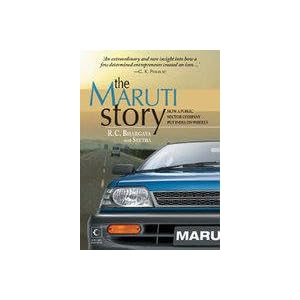
The Maruti Story and the RC Bhargava story

Business | RC Bhargava and Seetha


Well, The Maruti Story is not the autobiography, ghost-written or otherwise, of Mr RC Bhargava. Unlike many CEOs, Mr Bhargava does not write about himself. The entire book is bare of Bhargava anecdotes. About all you will get to know about him from the book is that he can mentally calculate faster than most people can manage even with calculators.
The Maruti Story
Hmm, not exactly all. You do get to know that he gives credit where due. Like having Seetha on the cover, and not relegated to the anonymous helping hack that most CEOs do. Like acknowledging a whole bunch of people who helped him find old documents to put the story together.

Oh, the book is great. It tells you about what Maruti does well, and a bit about what it didn't do so well. From my personal experience, I can say that you will get a pretty good insider (from the top) view of the company. It's written in a totally objective style, with very little personal viewpoint, but it bears his stamp, which is (you guessed it) a totally objective style. :)

So, I will write a couple of paragraphs on the still-unwritten The Bhargava Story instead.

Mr Bhargava is always considerate of junior people. He asked a young executive if she could stay beyond closing time to complete a piece of work, when he himself rarely left before 7.30. No other manager or director in Maruti used to do so; it was considered normal to spend an extra hour or two at work, and not to mutter and complain about it. Not that he'd usually ask anyone to stay back, anyway. He also made it a point to ask how she'd get back home, now that she'd missed her bus.

He put up a junior person who had worked on a project to explain Maruti's achievements to the public (journalists). The young man was featured in newspaper write-ups. However, the moment the journos started asking questions which moved the junior exec beyond his preparations, Mr Bhargava stepped forward to take the questions and shield him from stumbling. (Another MD of Maruti in similar circumstances once left the poor guy to face the wolves alone).

He never suffers fools, gladly or otherwise. He has patience, and uses it. But when he starts asking questions or making explanations v-e-r-y slowly, watch out. If he starts speaking simple Hindi, run for the hills.

He is awfully sharp, which you may guess from the fact that he was the IAS topper in the year he joined the service. He once spotted in 5 minutes the single error in a 60 page document, which two teams and three General Manager level people had checked, all no slouches in the brains department themselves.

And yet, people are surprised to find that he has no airs. When the GoI freed corporate salaries from the ceiling applicable till then (this was in the early 1990s), Mr Bhargava opined (I love that word!) that "Nobody is worth five lakh * rupees a year". The HR division had to gently but insistently explain to him that unless his salary as MD was increased, the rest of the Directors couldn't be paid more, either.

Mr Bhargava cannot stand liars and cheats. One person lost his job for exploiting the vague wording in some rules on indirect taxes. One lost it for lying about a project he had actually been going slow on, but claimed the papers were never with him. And yet, the CBI prosecuted Mr Bhargava for 'corrupt practices' till a sensible judge, albeit after fourteen long years, threw them out on their ears.

Anyway, I hope someday someone will write the Bhargava story, too. There is a lot we can learn from his life and times.

21 May 2012

How to type madly and avert nuclear war


Thriller | Karna Small Bodman

I always like to read how India is seen by 'other' eyes. Karna Small Bodman's Checkmate benefits from her insider view of the White House, which part of the book is very fascinating. Villainous militants of the banned Lashkar-e-Taiba are the villains here. They steal three ballistic missiles from a Pakistani base, with the help of conniving armymen sympathetic to their vision of a weird brand of Islam. They use/plan to use these to get India and Pakistan to have a war, whereupon they can take over Pakistan and it's nuclear arsenal, and then go sow the whirlwind. A computer scientist in the USA is developing a missile defense system which attempts to take over command of missiles in flight and direct them back to their sources. She becomes the center of the attempts by the villains. And then proceeds to rescue the world. Applause. Curtain.

It's interesting to me that despite getting advice from 'Robin Singh' about the cultures of Pakistan and India, and getting much of that fairly close to right, and avoiding naming either country as villains, she still manages to make a few bloopers. I guess the subcontinent's names are confusing enough to us insiders, that I should not be surprised that 'others' get these all wrong. I suppose you could name any American by taking two known American names of at random and swapping the two halves of each. Also, people there do tend to be named after Presidents. But 'Fakhruddin Venkatnaman', while not completely impossible, is so wrong on at least two levels. One, Venkatnaman is not a name, as far as I know. It's Venkatraman. And nobody is going to name their kid after both a Muslim Prez and a Hindu one. Especially not FA Ahmad. He's not exactly the best Prez we had, you know. Then, we move to Pakistani names. Nope, it is unlikely in the extreme that the Pakistani Ambassador to the USA is likely to be named Bhattia. Most most unlikely. Find out yourself why not.

Then the geeky objections. You cannot type madly and take over a missile. No, not even if the screen shows a graphic slowly crossing from one side to the other, and giving off tones and messages like a video game. No. Not happening. Not. Really. Trust me. I don't think you can even take over control of a radio-controlled model plane that way. Now, a more powerful transmitter on the same frequency, that would work. But not by madly typing away...

Ok, enough ranting. Nitpicks aside, well researched enough for popular fiction. Fast, easy read. Happy ending. 3 stars. But wait, did she get the White House insider stuff right? How would I know, right?

Next up: The Maruti Story by RC Bhargava, followed by science fiction and another thriller.

[Edit, 30 June 2012: Apparently, you can, indeed, take over a drone aircraft, as a bunch of students and $1000 worth of parts proved this week. But not by typing madly. By spoofing its GPS receiver. Ta da!]

The democratic nature of kings in fantasy


Fantasy and SF | Jim Butcher, Megan Whelan Turner and (Isaac Asimov, Martin Greenberg, Joseph Olander)-editors

I am extremely embarrassed to say that I do, after all, read not more than 3 books in 10 days. But, in my defense, they were mainly fat ones. Very fat.

First Lord's Fury by Jim Butcher is the sixth in the series. In the interests of avoiding spoilers, I will give no details. The 6th in a series is not necessarily the best point to dip into it, but this was a fast, fun read.

I do wonder at times about historical accuracy, even in fantasies. If you have hereditary rulers, I imagine that the discussion on the right thing to do would read very differently in a society in which that makes sense than it does in a democracy. Yet, the heroes in these stories have very democratic and enlightened approaches. It only makes internal sense if the 'internal' includes market forces in the real world. :)

That brings me to A Conspiracy of Kings by Megan Whelan Turner. The fourth in the series beginning with The Thief, and moving on through the equally enthralling The Queen of Attolia, and the breathlessly awaited The King of Attolia, has had less than rave reviews, some readers muttering darkly about it being disappointing. Considering that MW Turner is one of the two authors whose books I chase down and pester the booksellers about (this particular book was hand-carried for me from the USA, since it is not available in India), that sounded ominous but unbelievable. Halfway through the book, I dismissed such reviews as mere cavilling. However, on the last page, I had to admit that the word 'disappointing' was accurate. I expected more from Gen, damp it! It's tough for a writer to continue to maintain fantastic quality on plot, dialogue and characterisation in book after book, and I guess they get tired eventually. Or they get famous and the editors don't push as hard. Whatever. My offspring agrees that the end was surprisingly phuss, too. Still, a good enough book. Especially it's take on the rights and duties of the Barons. It shows you that when there are kings, the only people who have rights are the kings. In a democracy, we are all kings. Wouldn't change a democracy for other alternatives, no, no!

Don't read it unless you've read the first three books. Or maybe the other way round. Only 3 stars.

I also reread Isaac Asimov, Martin Greenberg and Joseph Olander's Science Fiction Treasury published in 1980. Many of the stories included are from as far back as the 1950s. Some of them are fairly dated, some even make you squirm. But some stay classic, like Who Goes There?, one of my all-time favourites despite some three or four cringy paragraphs, and Flowers for Algernon. I'm not doing a story-by-story here. It's good enough to read. Mostly. Though it's really, really fat.

11 May 2012

Game of blackmail

Legal thrillers | John Grisham

The Associate, is stated by the blurb to be 'reminiscent of The Firm,' which it is, somewhat. You have a young new lawyer, forced into doing things he wouldn't of his own volition, and using his cunning to get out of it. TL;DR summary: The Firm is better.