Showing posts with label The Pastel City. Show all posts

11 September 2018

A fallen sun, a whodunit and mindbending world-building

What more could you want? I’ve read several short stories by David Grigg and his short novel A Twist of Fate. I thought he had set high standards.
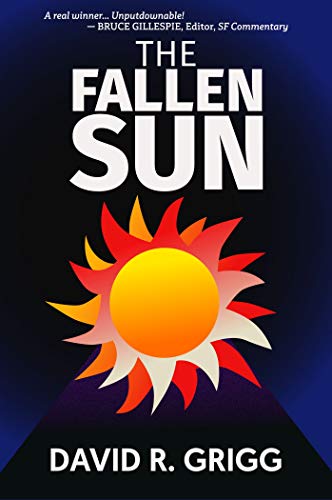
The Fallen Sun has just raised those standards further. It’s going to be difficult to avoid spoilers, because I’m so keen to share the wow moments in this book’s plot, but I shall control myself.

Three young people come of age (we’d call them older teens, but in the world of Sunfall, they are about ‘7 or 8 millends old’) and are faced with having their comfortable if unexciting worlds turned upside down, in a civilisation that is thousands of years old and has totally fossilised its working and culture. Candens and Campana of the Clan of Bellringers are brought up very differently. Only boys like Candens get taught the work of the high-class Clans, and girls like Campana have to content themselves with make-work like embroidery. Because, hey, they will get married and leak the Clan secrets. (Not that Candens, as a second son, has much joy of it either, bitterly watching his elder twin become an addict and wastrel.)

Campana’s friend and Candens' pledge, Adura, will have none of it. She is not keen to be traded as a pawn in clan politics, and joins a secret group. Which has an even more secret agenda.

Things go from bad to worse for our trio, as they get accused of murderous intent, get enmeshed in kidnapping, and get thoroughly framed by the real villains.

This is not a fantasy story, as you’d think at first, fallen sun and so on, but a well plotted sci fi with a fast pace, mindbending world-building, a carefully realised culture, wicked but human villains, a plot with plenty of twists, and whatever else you could want in a sci fi adventure of the very far future. All the while, David Grigg slowly pulls the world itself into sharper and sharper focus. Like any good sci fi, the world itself is a character. (Okay, okay, I promised no spoilers). There are plenty of wow moments as you realise what is really going on. The familiar becomes strange, and the strange becomes familiar as the book goes on. The characters grow upon you, and their flaws become endearing. By the time they are fully tangled in the web of deceit, you’re rooting for them all the way, and turning pages frantically to find out: what next??

The motives and methods of the villains are difficult to imagine until they slowly become revealed and perfectly logical after all. Like any good mystery, you go ‘of course!’ once you know the answer, and yet, like any good mystery, you can guess and guess and mostly guess all wrong.

This is sci fi of very high quality. You won’t be disappointed.

Read The Fallen Sun if you like... Terry Pratchett, especially if you liked Strata better than the Discworld books; M John Harrison’s The Pastel City; Jack Vance’s Dying Earth books, but you didn’t like that much callousness; historical mysteries and alternative history sci fi of the far past; sci fi that borders on fantasy; epic fantasy which makes sense (no magic); JRR Tolkein, but you would have preferred a faster read with real humans and less Destiny; YA; or sci fi with horses. It’s difficult to say more without spoilers, but this is hard sci fi though it initially reads closer to fantasy.

Disclaimer: I was a beta reader for the book (too greedy to wait for a David Grigg book to be officially released). Let me tell you, the draft version was compelling, but the final version had me spellbound--it blew my socks off, and I grudged my eating and sleeping time.

16 September 2012

Pastel visions

Fantasy | M John Harrison | The Pastel City; Viriconium Nights

This book was published so long ago that it didn't have blurbs on the back cover! (I must take a picture of the cover art and put it here, but, apologies, not today).

It does have a tagline below the book name: The greatest fantasy novel since Dune.

Two interesting personal observations about when I first read this book. One, I hadn't yet read Dune, which meant that that more-famous book now had to compete against The Pastel City as a benchmark. Two, it was a gift, which became embarrassing within 45 minutes of my getting it. The embarrassing part about the gift was that I read the book in about 70% of the time the gift-giver took to choose the book for me. In 45 minutes, I was challenged for reading the back of the book first, and reluctantly confessed to having almost finished the book. That was a lie. I'd already finished it within 35 minutes, and was on my first re-read.

The Pastel City can fit either classification, science fiction or fantasy. Since I'm reasonably certain most people have not read this slim gem, I'm giving a slightly more elaborate summary here, with fewer worries about spoilers.

The Afternoon Cultures, having exhausted the earth and most of space, die out after an unspecified number of millenniums. The remnant fallen men of the south, ruled by the men of the north, rebel, and establish the city and empire called Viriconium. Their technology is salvaged from the Rust Deserts, as is their metal. Unfathomable technology is beaten into blunt use in barbaric fashion. King Methven of Viriconium gathered, before the action starts, a group around him who had special talents, like Lord tegeus-Cromis, who 'fancied himself a better poet than swordsman', Norvin Trinor the strategist, Benedict Paucemanly who took a crystal launch and perhaps attempted a moon-landing, and others. He also married his brother to the Queen of the northmen. His niece, the Moidart, grew up scheming for his empire, and when the book starts, is attacking Methvet Nian, 'known in her youth as Jane' and her followers in Viriconium. All this in the prologue itself.

tegeus-Cromis, the introverted Lord, joins other Methven coming belatedly to aid their Queen: Birkin Grif, Tomb the Dwarf (who studied with Paucemanly), and old and dirtily old Theomerys Glyn. Looking for Trinor, Cromis finds Norvin has abandoned his wife in penury. He gets authorisation from the Queen and rides north (on horses, ahem) to take over the army and hope to defeat the northmen. As he races to catch up to Grif and the others who have gone on ahead, he is accosted by a metal vulture which insists he needs to immediately abandon all and go to a mysterious Cellur, aka the Birdman. Cellur warns of dire tidings, worse than a mere battle or a mere empire: Fear, he says, the geteit chemosit.

Pushing through psychedelic marshes, Grif's group of smugglers and Methven is attacked by a tall being with three red eyes, untiring, and armed with a force blade. Cromis beats it off, at the cost of his own small force blade, his unnamed sword, and his peace of mind. The monster has stolen the brain of the sentry, and Cromis has lost his authorisation in the swamp.

The bureaucrat in charge of the army refuses to recognise the group, and also ignores all useful intelligence. When the Moidart's army attacks, they don't expect the attack. Also with the army is a long line of black automatons, which she 'has dug up somewhere'. They butcher Methvet's army. Cromis, fighting, meets her general. Trinor has turned coat, but Cromis cannot kill an old friend. Cromis and some of the survivors are rescued by Methvet herself, fleeing the fall of Viriconium.

Cromis seeks out Cellur, who explains that the automatons harvest brains, and once they run out of enemies of the Moidart, will turn on her army and the populace. His mechanical birds transmit scenes of just such chaos. He trains Tomb to turn the brain-harvestors off, and explains where to find the control room. Cellur himself is older than his own memories, which are ancient, and probably dies protecting their retreat when they are attacked by chemosit under the Moidart's men, armed with force cannons and crystal launches.

Looking for the correct location, they are overtaken by Trinor, himself desperate to turn the geteit chemosit off. More deaths occur. Introversion is shown to be problematic (this was the 70s, okay).

Right. The empire is saved, but I'll leave the rest of the details for those who can still find copies of this little 180 page gem of fantasy/sci-fi.

The setting evokes both old Britain, as well as the psychedelic 70s when we all expected to see the end of the world--any day now--and technology was getting to be as advanced as magic. The writing is spare and crisp. The characters are well delineated, and the story progression inexorable yet unexpected.

And then, a few years ago, I came across another book by M John Harrison, called Viriconium Nights, which I promptly wasted money on. Harrison explores in this fat tome, alternate worlds of Viriconium. Alas, while hip and post-modern lit and all that, all four versions are depressing and do not measure up to the original. tegeus-Cromis appears in all four alternates, in roles not that of a hero, but ranging from patsy to villain, and Queen Jane morphs into a monstrous creature called Mammy Vooley. I have never reread this book, and will probably never do so, so bear with me as these memories are more than a decade old. Transplanting tegeus-Cromis into 1970s Britain was at best an exercise in horribleness. It's like graffiti executed furtively at midnight in stinking subway tunnels, in a bitter and sad parody of a great oil painting. Or like the worst alley scenes in the movie The Matrix crossed with black and white and red all over Kill Bill part 2, watched at night while bombs and rockets rain plaster around you and the voltage flickers. Or like a bad Stephen King book (not a good one).

As highly as I recommend The Pastel City, is exactly as lowly as I warn you off Viriconium Nights. It's almost as if they were written by two different people: the first by an optimistic and brilliant talent, and the second by a cynical and jaded also-ran academic with literary pretensions, bloated with fading fame and oodles of disrespect, attempting something clever based on something diamond-bright, but burying it in dirt instead. Sigh. How art the mighty fallen.

(I don't write like this normally. I'm infected with lyrical writing.)