Showing posts with label Hal Clement. Show all posts

29 September 2012

Charming little extraterrestrials

Science Fiction | Robert L Forward | Dragon's Egg

Robert L Forward had multiple degrees, some of them at doctorate levels. In engineering. And several patents. So, you can guess he was really, really smart. Larry Niven and Jerry Pournelle used to visit his lab so that they could cadge cool new ideas for their latest books--there's a Forward mass detector in Niven's Hole Man, for example (that's actually real technology).

So, wouldn't it be so much better to read the man's science-fictionish ideas direct? I actually approached the concept with some trepidation--not everyone can write a great story, even with mind-bending physics as a supporting character. So, I started off small, with Indistinguishable from Magic, which is mainly a collection of essays, with the occasional short story. Hmm, I said to myself, the stories are relentlessly upbeat. How much of that can I take? Can I really read a whole book with no villains, no evil human impulses? How will the story progress without the spice?

Turns out, I can take a good solid chunk of it! Which brings me to Dragon's Egg.

Dr Forward (the books are sold without the 'Dr', which seems disrespectful of his achievements to me) has written a book about extraterrestrials. Indeed, they don't live on a rocky planet. Heck, they don't live on a planet, they live on a star. A teeeeny little star. Really teeny, only 20 km across, and with a ferocious gravity gradient. Not to mention the magnetic field.

OK, backing up a bit. An astronomer graduate assistant discovers a neutron star doing a close sweep past the solar system. Her son grows up completely irritated that Mom's discovery was credited to her advisor, and becomes not only an expert on neutron star physics, but also a science writer of renown. Therefore, when it is decided to send a manned scientific mission to the star, the young Niven (hee hee, you spotted that, too, did you?) is the natural choice to lead the mission.

In parallel, we witness the rise of a new species on the neutron star. Dr Forward gives a hat-tip to Hal Clement in the appendix where he describes the species, saying that in all other respects than specifically mentioned, the species' reactions are like those of Clement's ETs in A Mission of Gravity. Except that here, we meet the females of the species, too, it being a more egalitarian society than the one on Mesklin. Clement just wrote boys books for a long time before expanding scope to include girls, too. Forward, whose wife is described in the 'About the Author' page as 'contumacious', clearly did not believe a woman's place is in the kitchen, and had succeeded once in driving a less sensible editor crazy with stories featuring a woman asteroid hunter.

By the time the humans reach the star, the aliens have progressed to mathematics, religion (for a short while) and temple building. The building is awesome enough for the humans to spot it from orbit. So they contact the aliens.

Thing is, the aliens' lives are much much faster than ours, since their reactions are nuclear, not chemical. By the time you say hello and a bit of chit-chat, the alien you are talking to is ready to die of old age. The humans beam down an encyclopedia. The aliens start to learn at a ferocious rate...

Noooo, that's not the charm of this book. The charm is in the physics and engineering. Think about it. How do you get humans within 400 km of a neutron star? The answer features antimatter, but in a literally throw-away fashion. Keep thinking.

Dr Forward called this book a 'textbook on neutron star physics disguised as a novel'. The publisher's blurbs include praise from scientists, science fiction writers, and one reviewer in a regular science-fiction-reviewer mode.

The problem is, the rest of his novels are not available in India, not even in second hand shops. Wail.

If you like Hal Clement books, you will love Dr Forward books and stories. If you like stories where good, decent people enjoy challenges thrown at them by the universe instead of evil people, this is your one-stop shop. If you like happy endings, yay-time! OK, you get it: I loved the book, and recommend it unreservedly. However, parents, don't let the kids in your house who are aged over 14 read this book first. Dang, they may understand it better than us adults. :D

11 May 2012

Oh, still November, re-reading yet once more

Science Fiction | Hal Clement


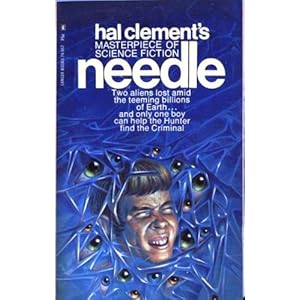
Currently re-reading Hal Clement's Needle


This book was first published in 1949, way before most of us were even born. Hal Clement was a school teacher of physics, and most of his books feature aliens and/or kids. This one is no different, it has both. :)


It also has these reminders of the 1940s, which are just as often double-take moments as quaint and somehow cute. A population of 2 billion. Only! 15 year olds on bicycles, who also drive jeeps and casually ask permission to go blow up something with a stick of dynamite. (What!?) And turbo-prop planes, while the biology people have created bacteria that convert vegetable matter to oil. And a school syllabus of English, Physics, Latin and French. I kid you not.


So, the alien, a virus-based lifeform with amoebic shape, crashlands on earth while chasing an alien murderer. Being a symbiote, it hunts for a suitable host. Kills a shark (unsuitable), but then finds a boy. So, now the Boy holds the Fate of Earth in his Hands. Because the alien enlists his help in hunting down the villain. Who is hidden in the haystack of 2 billion, and the needle, as the book says, has crept inside one of the straws.


The first 70 pages cover the story till the point that the alien establishes communication with the boy he lives within, and persuades him to return to Hawaii to track down the criminal. I'm about at this point.


OK, I've forgotten who is the person who ends up harbouring the villain, and whether he did it voluntarily or not, and how the villain was tracked and arrested, and how they went home. But it's a Hal Clement book. Happy endings for all. :)


Anyway, I strongly recommend Hal Clement books for young teenagers of all ages. He used to check experimentally all the weird atmospheres and reactions he reported (except probably Mission of Gravity).


More Hal Clement books I've enjoyed: Mission of Gravity, it's sequel Starlight, Close to Critical, Nitrogen Fix and even Iceworld, whose gangsters and cops aliens compensate for the thoroughly dated humans in it.


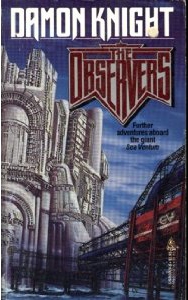
More books/stories about intelligent alien symbionts: Damon Knight's series CV, The Observers and A Reasonable World, which feature their own set of baffling humans and straightforward symbionts. Robert Silverberg's stories, Amanda and the Alien, in which again, Amanda is the weirder, and The Symbiont, a creepy piece that will stay with you long after it's done (both stories are in his collected stories vol 1: Pluto in the Morning Light).


Still November, still re-reading


Science fiction | Larry Niven

Recently re-read Larry Niven's A Hole in Space, a collection of short stories. My last post on the topic covered the first three stories.


All the Bridges Rusting is a space story based on the instant-elsewhere booths manufactured by JumpShift. Some have been put on drop-ships, whose only purpose is to absorb the enormous potential energy differences between the spacecraft here and the spacecraft out there. Some are self-transmitting ships. In the meantime, thirty years before, a slowship had set out to explore planets around Centaurus. The transfer booth ships reach first, and find the old ship is in trouble, not having made its slowdown maneuvres. Now, it's zipping along at 7% of the speed of light. Dr Robyn Whyte, ex-head of JumpShift, is faced with the impossible rescue, and how to explain it to a public no longer interested in space. Prophetic, that last. This is Larry Niven in ideas mode.

There is a Tide is the earliest Louis Wu story. Louis Wu stars in Ringworld, and in a few earlier stories. In this one, he is out alone, looking for stasis boxes left behind by the extinct rulers of space, the Slavers. He finds what seems to be the biggest one ever found, but things are not simple. Another, new alien species, has found it at the same time. Fight, flight, or gamble? This one is in way-out problems mode. Larry Niven loves tides. Read Neutron Star if you don't believe me.

Bigger than Worlds is a madcap essay, covering all kinds of giant spacecraft, why we will need them, and how they will get inevitably bigger with our overcrowding problems. Not fiction, but a tremendous display of science writing at the edge of fiction.

$16940.00 is not a science fiction story. It's about a blackmailer, and the blackmailed, and how they are tied together, and ... just read it, ok.

The Hole Man was written when the first quantum black holes were postulated. As Niven's friend Jerry Pournelle gleefully cackled later, Niven got into print about quantum black holes before Pournelle, but the science is wrong. Quantum black holes are black body emitters. Ah, dang it, it's a murder mystery. Of sorts. You realise only later that there are two murders, not one. This was an award winner.

The Fourth Profession is one of the eeriest Larry Niven stories I've read. The Monks, space aliens, visit Earth. One of them walks into a bar... OK, I should stop laughing. The bartender discovers more than he finds comfortable. Now only he can save the Earth... If you ever get a chance to read this one, do. It's Niven at his maddest inventiveness. It's also a story that showcases why Niven stories age so slowly in many ways. He was ahead of the times.

Anybody interested in more thoughts about instant-elsewhere transport? Try Harry Harrison's One Step From Earth.


Next up: Re-reading Hal Clement's Needle