Showing posts with label Harry Harrison. Show all posts

29 May 2012

The zombie virus meme

Fantasy | ZA Recht

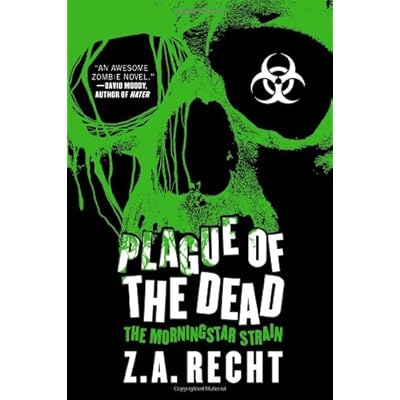
Some days, you just need a good zombie story to curl up with. The first zombie story I remember as being satisfying was Larry Niven's Night on Mispec Moor. I think that was the first zombie story which was based on a natural cause for zombies. Prior to that, mysterious spells and juices caused zombiehood. In Mispec Moor, it was a pathogen which walked the dead, yes yes, impossible I know, and... ok, no spoilers. I still love the very clear development of the story and don't want to spoil it for those who have not yet read this one.

So, coming to Plague of the Dead, we again have a pathogen, here, a virus, which causes people to become zombies. Biting healthy people to spread it, and needing a shot to the head to kill the zombies.

The zombie virus is called the Morningstar strain, and we first encounter it in ... emails from a US Army doctor. We next see it in action in Africa. Pretty soon, the entire continent is abandoned to the disease and quarantined off. Too bad for the people there. I assume market research does not show many readers of US zombie books on the continent, so they can all be fictionally knocked off conveniently.

Anyway, as you would expect, the virus escapes. But before that, you get army guys doing their thing, doctors and journos doing their thing, and the zombies doing their, ugh, thing. A complication ensues when the Army doc leaks the truth about there really being zombies to the press. She and the journo are arrested by a secret agency and tortured as traitors. In the meantime, the virus gets loose in the USA.

You've seen zombies in many movies and TV serials, most of them caused by viruses. This book builds on the very same memes. A fast read, but not conclusive. It's written as book one of a series, and it's clear this is not a completed story yet. Since I haven't read the next book, it's not really a spoiler to guess that it will turn out to have been a manufactured virus.

The only thing that all the virus-zombie stories ignore is that, once dead, the body cannot be reanimated that easily, though biting people to spread it would make perfect sense for the pathogen. Don't think it doesn't happen--pathogens do change the behaviour of the host to make it do stupidly fatal things to get itself to spread faster. But a zombie virus would have to run a brain to run the body, which is much too complex for a virus to run. Most humans cannot manage it despite all the right DNA and practice. Unless the virus is intelligent. Hah. I'm not going down that equally dopey slope unless I decide to write a zombie book myself.

Still, as I said, once in a while you want to read a zombie book, for which this is plenty good enough. 3 and a half stars. If the next book falls into my lap, I will certainly read it, but I'm not going to stand in lines to get it.

***

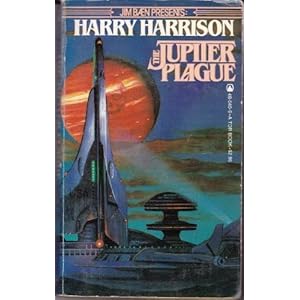
For an intelligent pathogen, try Harry Harrison's The Jupiter Plague. Surprise ending, there. There's also another book I remember reading about an engineered virus that cycled through different forms based on an algorithm (I bet both mathematicians and biologists who read it died laughing though it's good enough for us laypeople), but alas, I forget both the name of the book and the author.

11 May 2012

SF keeps December warm in the northern hemisphere

Science Fiction | Harry Harrison
Since I posted last, I reread Harry Harrison's The Jupiter Plague.


Harry Harrison has written an incredible number of books, ranging from silly easy reads to thought-provoking easy reads. He's written science fiction, comedy (the Revenge series, e.g. Queen Victoria's Revenge), and comic science fiction, and goodness knows what else besides, not only in English but in Esperanto. The Jupiter Plague is straight science fiction.
It features Dr Sam Bertolli, an ex-UN Army man who becomes a late student. As an intern on the ambulance detail, he gets to meet up with the long-missing and recently returned "Pericles", a ship that actually landed on Jupiter and returned. A member of the crew emerges, falls sick and dies despite the best efforts of Sam and Nita Mendel, a pathologist, dies. And he's locked the ship tight. Everyone worries about another plague (there was one when the first expedition returned from Venus), and a team is formed to analyse this new disease. Next you know, birds are dropping dead. Infected birds infect humans and birds, but humans don't infect humans. So, they try to cull all the birds. Ha, you say to yourself, like the bird flu thing a few years ago. Yeah, but this book was written in 1965 and revised in 1982.

Anyway, some people protect their birds, but others attack them. Then the whole area goes under quarantine, but a mob breaks out. And in the meantime, dogs start getting it from birds, and transmitting back to humans.

OK, so in the 1960s, humans were special, and a plague would naturally attempt to attack humans, right? Not fish or prokaryotes, right?

Never mind. At some stage, Sam realises that he needs to reexamine the ship before the panicked world leaders camped in Geneva drop an atom bomb on the city.

OK, OK, you don't want any more spoilers. :)

A thought-provoking book with a nice open ending.

Another of my favourite Harry Harrison fast-action-think-later books is Invasion Earth, where again the woman in the story has a totally different view of the situation, partly 'cause she's Russian--maybe. And it has two different, new aliens.
  

Other Harry Harrison books which are great fun are the Stainless Steel Rat series, the Deathworld trilogy, and One Step from Earth. His series on Bill the Galactic Hero is a comic army story based in the far future, but it's basically different episodes of the same concept, and the first in the series is the best. (And, yes, the artist who drew the cover can draw well; read the book if you don't believe how well).

If you haven't read Harry Harrison, start now.

Still November, still re-reading


Science fiction | Larry Niven

Recently re-read Larry Niven's A Hole in Space, a collection of short stories. My last post on the topic covered the first three stories.


All the Bridges Rusting is a space story based on the instant-elsewhere booths manufactured by JumpShift. Some have been put on drop-ships, whose only purpose is to absorb the enormous potential energy differences between the spacecraft here and the spacecraft out there. Some are self-transmitting ships. In the meantime, thirty years before, a slowship had set out to explore planets around Centaurus. The transfer booth ships reach first, and find the old ship is in trouble, not having made its slowdown maneuvres. Now, it's zipping along at 7% of the speed of light. Dr Robyn Whyte, ex-head of JumpShift, is faced with the impossible rescue, and how to explain it to a public no longer interested in space. Prophetic, that last. This is Larry Niven in ideas mode.

There is a Tide is the earliest Louis Wu story. Louis Wu stars in Ringworld, and in a few earlier stories. In this one, he is out alone, looking for stasis boxes left behind by the extinct rulers of space, the Slavers. He finds what seems to be the biggest one ever found, but things are not simple. Another, new alien species, has found it at the same time. Fight, flight, or gamble? This one is in way-out problems mode. Larry Niven loves tides. Read Neutron Star if you don't believe me.

Bigger than Worlds is a madcap essay, covering all kinds of giant spacecraft, why we will need them, and how they will get inevitably bigger with our overcrowding problems. Not fiction, but a tremendous display of science writing at the edge of fiction.

$16940.00 is not a science fiction story. It's about a blackmailer, and the blackmailed, and how they are tied together, and ... just read it, ok.

The Hole Man was written when the first quantum black holes were postulated. As Niven's friend Jerry Pournelle gleefully cackled later, Niven got into print about quantum black holes before Pournelle, but the science is wrong. Quantum black holes are black body emitters. Ah, dang it, it's a murder mystery. Of sorts. You realise only later that there are two murders, not one. This was an award winner.

The Fourth Profession is one of the eeriest Larry Niven stories I've read. The Monks, space aliens, visit Earth. One of them walks into a bar... OK, I should stop laughing. The bartender discovers more than he finds comfortable. Now only he can save the Earth... If you ever get a chance to read this one, do. It's Niven at his maddest inventiveness. It's also a story that showcases why Niven stories age so slowly in many ways. He was ahead of the times.

Anybody interested in more thoughts about instant-elsewhere transport? Try Harry Harrison's One Step From Earth.


Next up: Re-reading Hal Clement's Needle