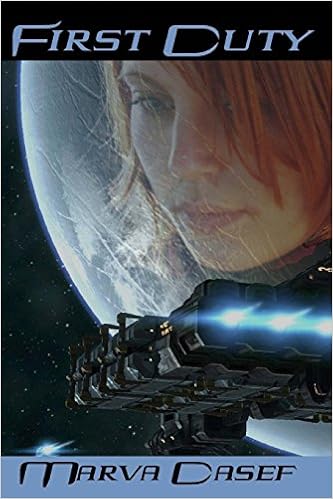
Science Fiction for Young Teens | First Duty | Marva Dasef
I know Marva Dasef as the author of the gentle, imaginative and exploratory books of the Abu Nuwas series, and so I was looking forward to First Duty, bearing in mind, of course, that this time we are talking science fiction and not fantasy. I’ve also read her other fine books, Lemons and Other Kid Tales and Fish Story, so I grabbed the chance to pick up First Duty on a hefty discount when Marva Dasef did a giveaway. I was pretty confident I’d get something suited for kids of ages 12-90. No gruesome horrors, wicked but not evil villains, simple but not simplified plots.
First Duty does not quite pull off the same standards. Don’t get me wrong: the writing is crisp and the editing flawless, which already lifts the book head and shoulders over most indie books. But it’s in the reasoning that it stumbles. When Abu Nuwas asks a young boy whether it is right for girls to be disallowed from certain activities, he lets the boy reason it out for himself. Nyra, the protagonist of First Duty doesn’t quite reason anything out. She goes from action to action much like a TV serial heroine. There are twists and turns in the plot, but none of the mind. Freedom is presented to us as an unalloyed good, losing the chance to explain to young readers what exactly is wrong when corporatisation of whole planets results in poorly-fed slave labour. The desperation of the tall and martial-arts-talented Nyra to get off-planet is there, but there is no back-story to explain why. We know there is inequality in the whole setup, but we barely brush the fringes or implications of it.
Nyra survives the initial test (ha, you guessed that, did you?) and the first chapters did bring out a bit of the heartlessness of the system in that cadets could be and did get killed in the last test, for no real reason other than ‘testing’. She then is part of a mission to deliver a rebel to prison, where she gets to know for the first time that there is a rebellion, and what the reasons for it are (freedom, equality).
At this point, I felt that Nyra is a naif. But is she? She’s supposed to be one of the smartest cadets, and she is selected, after all, to infiltrate the rebels, once she’s presented that plan as a fait accompli. So, plenty of initiative, smarts, physical capability, and perhaps charm, to be able to convince the rebel leader she is a committed rebel.
She meets a lot of rebels, and finds out more about the status of the rebellion on her own home world, something she had been blithely ignorant of. Are real teens that ignorant? It’s possible, but surely a sharp young woman like Nyra would have known something more than she does. Or is she like the many one-track minds one sees alas too often in academia, someone who scores well by single-minded focus, and therefore not a rounded personality with other interests?
She goes from adventure to adventure, with a final result you can expect from reading the back cover or my own headline for this post (spoilers? Who, me? Never!) And yet, somehow, it seems not to quite touch her at any depth. Not the unexplained sexism of her first Captain, nor the suspicion of the second. It’s all: huh, I shall prove to you that I am capable. Nyra is too perfect already, there is no scope of showing growth in the character.
Another lost opportunity is the Vargans, including one of Nyra’s few friends, Smith, who is her contact back to headquarters, someone who follows her into the rebel stronghold under the guise of a romance. Dasef has created a super-race of humans adapted to extreme environments, one of whom is the laid-back Smith. However, the special organs and abilities don’t actually have anything to do in the story. I hope the sequels will put these to better use.
All in all, a light read, with a light touch, and a light treatment. Anyway, I’m off to read the first of Marva Dasef’s Witches of Galdorheim.
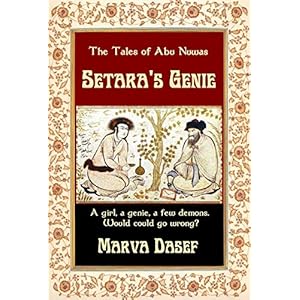 Setara's Genie is the first Abu Nuwas book. Abu Nuwas is a story teller. In this novel, he tells an eager audience the stories of Setara's Genie. Setara finds a genie (of the magic lamp type), but he is remarkably reluctant to do for her anything she can do for herself. Some of the magical things he actually does, result in great hilarity, like when she asks for (and gets) a handsome prince who loves her madly. Setara grows from a teen you would roll your eyes at to someone whom you really like.
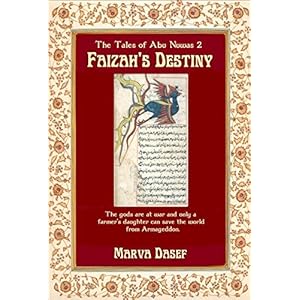 This is followed by the second Abu Nuwas book, Faizah's Destiny. How does he solve this second young person's issues through pertinent stories?