Showing posts with label SF. Show all posts

09 June 2019

Hard sci fi that bends reality very convincingly

Science fiction | Ball Lightning | Cixin Liu

⭐⭐⭐

Good, but not as good as the Three Body series or Wandering Earth.

I like Joel Martinson's translations better than Ken Liu's. Let's get that out of the way directly. Ken Liu's are more faithful, Joel Martinson's flow.

Chen sees his parents incinerated by ball lightning on his 14th birthday, and therefore grows up to be a ball lightning researcher. The only way something as rare as this gets funded for research is military applications. He meets and works with Major Yun Lin, who is a reckless but influential person with a searing interest in new weapons of all types, the more quixotic, the better. They are joined by the cantankerous genius theorist Ding Yi (who also shows up in the Three Body series).

What eventually happens to Yun Lin is an outcome of her psychology, quite fascinating and heh heh, quantum. And I have never, ever, come across such a way of concluding a war as in this book. Trust you me, MAD is nothing.

Ball lightning turns out to be something that Cixin Liu specialises in inventing: strange forms of matter that seem superbly convincing while you read the book. You have to finish the book, roam around outside, touch a few solid things, and check on the Internet that, since the book was published, scientists have actually found out what it is (and it's not what's said in the book, thank goodness for that!), and then return to the normal world after the mad roller coaster ride of imagination.

This book has a slower pace and not as large a sweep as the Three Body series. But it is a prequel. Fans of the series should read it; they will not be disappointed.

3 stars = I liked it

10 June 2012

What if you could solve the world's problems?


Science Fiction | David Grigg

David Grigg is an author I first came across on Bliss Morgan's writing prompts Google+ page, Days of Grey, I think. He wrote every single day on the picture prompts. The quality of the flash fiction was between very good and excellent. (Much of that is collected in a book, A Torrent of Story).


I've just downloaded and read his latest novelette, A Twist of Fate, from Amazon. Like his other stories that I've been lucky enough to read, this is very well-crafted, and takes a subtle look at society and science. An ethical question in dimsum-sized meals.


(I also love the cover, and, yes, it does relate to the story, and is not a random cool image to attract science fiction readers).

Strongly recommended!

What are you waiting for? It's free for a few more hours (at the time of posting; no longer)! Return on investment = infinity.

Some of his other stories are also on Amazon and on The Narratorium. Go right ahead and pile in.

07 June 2012

Farewell to the Flesh

Science Fiction | Elizabeth Bear

Carnival comes across as the nth book in a series. I got the niggling feeling that things had happened before, which I should read something else to know about. But then I got the feeling that, if this was true, it was a very good series novel, since by mid-book, you get to know the world, the advanced technology, the social state, and all the rest of the things that ... slow down, that you expect to grok by mid-book in a good SF book anyway. Hmm, not, after all, a series novel, but possibly another in a 'world'. I need to go read E Bear's earlier books.

Vincent Katherinessen and Michaelangelo Osiris Leary Kusanagi-Jones (huff, puff) are Old Earth spies sent to New Amazonia to act as diplomat-agents, several decades after the last invasion of New Amazonia by Old Earth failed spectacularly. Vincent and K-J (I cannot imagine the patience Elizabeth Bear has to keep typing that name in full!) are clandestine lovers, one a truth teller and one a Liar, separated when discovered to be lovers and brainwashed into hetero life (lots of people in this country would love to have that technology; some even claim they do already), or are they? But New Am does not allow stud males on-planet, so they are dragged out of various disgraces and despatched there. New Am has discovered the first ever alien artifacts, and is suspected of having free clean energy, a bounty slavered after by Old Earth.

Old Earth in ancient times had created Governors, and programmed them to ensure that any human who was not completely environmentally friendly was 'assessed' and killed. Now, the Governors enforce local laws so long as the culture is environmentally friendly, which New Am is. In spades.

The local culture is macha. Female version of macho. Duels, gunslingers, and no male can aspire to anything except being 'gentled' or else having to fight to live in the Games in the Carnival. Culture clashes and the viewpoint of the suppressed form a large part of the charm of this book.

Sample, from an early scene where Vincent is nauseated by the food on offer:

"The food isn't to your liking, Miss Katherinessen?"
... "We don't eat animals," he said negligently. "We consider murder barbaric, whether it's for food or not."
..."Strange," Montevideo said. ... "I hear some on Coalition worlds will pay handsomely for meat."
"Are you suggesting you support illegal trade with Coalition worlds?" Vincent's smile was a thing of legend. Hackles up, Montevideo took a half-step forward, and he was only using a quarter of his usual wattage. "There's a child sex trade, too. I don't suppose you condone that."
Montevideo's mouth was half open to answer before she realised she'd been slapped. "That's the opinion of somebody whose government encourages fetal murder and contract slavery?"
"It is," Vincent said. He pulled his hand from his pocket and studied his nails. ...
And then Vincent looked up, as if his distraction had been a casual thing, and gave her a few more watts. He murmured, almost wistfully, "Now that we've established that we think each other monsters, do you suppose we can get back to business?"

There, our spies meet the local truth teller, Lesa Pretoria, and the assorted cliques that create the complications that move the story forward. There are assassination attempts, upturned views, double agents, hidden meanings, more double agents, aliens, technology, parents, still more double agents, people.

And I love the tech. Nothing is explained. It just is. The House that creates rooms and facilities as required. The watch which generates a wardrobe, which turns out to be a 'weaponised utility fog'. I love this kind of science fiction. It soothes me, and reassures me that imagination is valued and live and kicking.

Recommended reading.

Page-curlingly hot writing - Goodbye Ray Bradbury


Ray Bradbury


As a teenager, I fancied writing science fiction. One day, I wrote a few pages, and then threw them across the room, because they were too Bradburyesque for my liking (I'd just been creeped out by a Cece story).


Then I crawled around and rounded them up because they were the best bits of writing I'd done in my life till then. A few years later, I read Dandelion Wine, still my favourite Rad Bradbury book, and then the super-creepy Mars stories...

If I ever reach peaks of Bradburyesque writing again, I guess my days will be made.

Goodbye, Rad Bradbury.

02 June 2012

Catholics vs. Atheists; no contest

Science Fiction | Kay Kenyon

Spoiler warning: Much of the plot is leaked here, but not all.

Maximum Ice is not about ice. A generation ship returns to Earth, not having found any habitable planets, and running out of children, due to radiation damage. The crew hopes to resettle, after ten thousand years, but finds the planet girdled by a giant quasi-crystal called Ice. But it's not ice.


The crew maintains purpose by re-stuffing Ship Mother Zoya Kundara into cryo-statis after she's been around for a few weeks. She maintains the memory of what they are (gypsies, persecuted on Earth for being immune to a lethal pandemic, and getting the world's only generation ship in compensation, a case fought by Zoya the linguist), and resurfaces whenever they need. The Captain, Anatolly, is being challenged by his first mate, Janos. Janos then allies with the people on the ground, called the Sisters of Clarity, who are atheists, but maintain the trappings of Catholic nuns. These include black robes, separation of the sexes (and suppression of the Brothers), arbitrary rules in the dormitories, diminution of self, petty punishments, unquestioning obedience to The Faith, and low-hitting politics. That they pretend to be Sisters of any type is felt to be abominable by the ship's Catholic priest, an AI programmed by the third Vatican to keep the generations on the strait and narrow (yes, I know how to spell straight). The one who do the questioning are the believers in God and the Pope (long dead); the scientific Sisters keep trying whatever they tried and failed at for all these centuries, because they don't like trying anything new, they just keep flailing at their holey purpose. Urgh.


Now the evil atheists make common cause with zombie cannibals created by Ice in its pursuit of longevity for the last of the evil scientists who created it. (The good scientists died of despair after creating Ice to save the world from dark matter, which sucked out 'information' in a weird across-space action-at-a-distance vacuuming for some unstated but implied purpose. Having brought apocalypse to the world, it benignly moves on to other parts of the galaxy to do more feeding on 'information'.)

For 10,000 years, scattered preserves of throwback people dug into decayed cities to find electronics and raw material, most of which found its way into the baby-slaver Sisters' greedy little hands. Treasures of wooden carving, they piously say, are 'volunteer labour', yeah, right. The Sisters now barter these babies to the crew of the ship to induce them to mutiny against their (elected and no longer popular, likely to lose the next election, but till then absolute ruler by divine right) Captain.

In the end, all those godless villains get their comeuppance, and the pure strain of Catholicism wins against all evil, Ice repents and everyone is saved.

It's not that the book is written badly; it's got beautiful writing. Sample pretty prose: Darkness engulfed him, and his body filled with tears. When the hot, salty water got as high as his eyes, tears spilled out.

But what are a perfectly empathetic set of characters get ruined for me by this relentless, if written with a light touch, all-pervading religiosity, in which the attributes of scientific discovery are appropriated by the unwavering believers, and the attributes of blind religion are ascribed to philosophers. Evil scientists and even more evil atheists are abusers of males, cruel, and, in case you didn't hate them enough by now, torturers and cannibals to boot. The Good Catholics, on the other hand, maintain steadfast and invariant love of the Catholic Church and all its practices for ten thousand years and so vanquish all, finding natural allies in the preserves where otherwise good people are gratuitously stupid or callous and sell surplus children, but all is well because they teach the kid who is the great hope of humankind that she must believe in God, which she does, all the while designing robots that cutely run into the public and destroy things. And the Ship Mother gets blissfully sacrificed on a daily (or monthly) basis, and wholly sacrificed in the end of the book, so that everyone else can be saved, and she is so unquestioningly happy to do so. And the whole cast thinks this is the normal and sensible thing to do.

Urgh. Even the mandatory 'happy ending' didn't cheer me up. What could have been a thoughtful examination of flawed people turned out into casting a bunch of cranks as the wonders of the world and all others as evil, some more and some less.

Nope, not going to pick up Kay Kenyon again.

21 May 2012

The democratic nature of kings in fantasy


Fantasy and SF | Jim Butcher, Megan Whelan Turner and (Isaac Asimov, Martin Greenberg, Joseph Olander)-editors

I am extremely embarrassed to say that I do, after all, read not more than 3 books in 10 days. But, in my defense, they were mainly fat ones. Very fat.

First Lord's Fury by Jim Butcher is the sixth in the series. In the interests of avoiding spoilers, I will give no details. The 6th in a series is not necessarily the best point to dip into it, but this was a fast, fun read.

I do wonder at times about historical accuracy, even in fantasies. If you have hereditary rulers, I imagine that the discussion on the right thing to do would read very differently in a society in which that makes sense than it does in a democracy. Yet, the heroes in these stories have very democratic and enlightened approaches. It only makes internal sense if the 'internal' includes market forces in the real world. :)

That brings me to A Conspiracy of Kings by Megan Whelan Turner. The fourth in the series beginning with The Thief, and moving on through the equally enthralling The Queen of Attolia, and the breathlessly awaited The King of Attolia, has had less than rave reviews, some readers muttering darkly about it being disappointing. Considering that MW Turner is one of the two authors whose books I chase down and pester the booksellers about (this particular book was hand-carried for me from the USA, since it is not available in India), that sounded ominous but unbelievable. Halfway through the book, I dismissed such reviews as mere cavilling. However, on the last page, I had to admit that the word 'disappointing' was accurate. I expected more from Gen, damp it! It's tough for a writer to continue to maintain fantastic quality on plot, dialogue and characterisation in book after book, and I guess they get tired eventually. Or they get famous and the editors don't push as hard. Whatever. My offspring agrees that the end was surprisingly phuss, too. Still, a good enough book. Especially it's take on the rights and duties of the Barons. It shows you that when there are kings, the only people who have rights are the kings. In a democracy, we are all kings. Wouldn't change a democracy for other alternatives, no, no!

Don't read it unless you've read the first three books. Or maybe the other way round. Only 3 stars.

I also reread Isaac Asimov, Martin Greenberg and Joseph Olander's Science Fiction Treasury published in 1980. Many of the stories included are from as far back as the 1950s. Some of them are fairly dated, some even make you squirm. But some stay classic, like Who Goes There?, one of my all-time favourites despite some three or four cringy paragraphs, and Flowers for Algernon. I'm not doing a story-by-story here. It's good enough to read. Mostly. Though it's really, really fat.

11 May 2012

The Paving on the Way to Hell

Fantasy/sci fi/YA | Patrick Ness
Warning: minor spoilers

Last month, I finally read the second and third books in the Chaos Walking trilogy, The Ask and The Answer and Monsters of Men. Considering that these books are not available in India, and I had to get someone to handcarry them for me from the USA, you can be sure the first book, The Knife of Never Letting Go, must have had something going for it. The first book introduces us to Todd, the last boy in Prentisstown, a town on another planet, with very American settlers. But you are on another planet, you realise. Everyone can hear everyone else's thoughts here, and there are no women. The Mayor wants something from Todd. His parents (both men) want him to escape. Todd runs. Meets Viola, the sole survivor of the crash-landing of a scout spacecraft from the second wave of settlers. But the Mayor is after him. Todd and Viola run for Haven. The Mayor follows, with death in his wake. At the end of the book one, we are faced with the truth of Haven.

Book two, The Ask and The Answer, has Haven resisting the Mayor. But the Mayor has mind-control. And the only cure for the incessant leakage of men's thoughts. Yet Todd wins. Or does he? This book humanises Davy, a great achievement.

Book three, Monsters of Men, refers to 'war makes monsters of men'. What does the Mayor want? War. And he gets it. War with the aliens who live on the planet. (Aha, shades of American settlers again). And what does everyone else want? Peace. So what do we get? War. Is this book as grimly relentless as book one? Hmm, given that book two held out more hope than book one, you can safely guess: no.

A great series. Good for all young and not-so-young adults to read and enjoy. And, despite having one of the most villainous villains ever, as well as a social construct that is all too evilly possible, this book is less grim than the series by Peter V Brett.

Enjoy!

Amnesiac adventure


Fantasy/sci fi | Julie E Czernada

Last month, I reread A Thousand Words for Stranger. This is biologist JE Czernada's debut novel, coming out of her musings as to what biological gains would justify heavy investment in reproduction, up to and including the life of the individual.

It's an amnesia story. The protagonist has lost her memory—everything is gone except a batch of compulsions. Slowly, things become clearer, and the villains are unmasked one by surprising one. A sweet story, getting slightly predictable towards the end—just before new surprising twists. Very enjoyable, but somehow, I never did go out madly hunting the next in the series. If it drops into my lap, I will buy it and enjoy it (the whole series), but I won't go chasing.

Excerpt:
I stared at the hand pressed near my cheek. It had five fingers, tipped with small, blunt nails, one broken. There were smudges of dirt on the parm and back; the clean skin was paler, except where a spiderweb of red marked the edges of a cut. It was mine, I decided, confused by the delay in recognition.

:)

A Cultured Inversion


Science Fiction | Iain M Banks

I re-read Inversions last month. This is the book in the Culture series which is closest to convincing you that it is not, and is a fantasy instead. I read the book twice the first time to get the Culture-y parts right. It keeps the secrets/suspense till the last page. I loved it. Still do.

Miles to go

Science Fiction | Lois McMaster Bujold

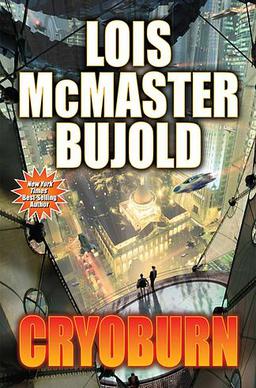
I reread the Young Miles omnibus, which has The Warrior's Apprentice, The Mountains of Mourning,and The Vor Game by one of my favourite authors (top 3, to be precise), Lois McMaster Bujold. And then I read the latest novel, Cryoburn, which I'd got someone to buy and hand-carry for me. Whee!

The Miles Vorkosigan series is great fun, space adventures with satisfyingly complex plots, villainous but human villains, heroic but human heroes, and pithy observations on what constitutes integrity, among other things. I frequently mutter that it's a shame these are not nominated for the Nobel prize. At least people would enjoy reading Nobel winning material when it wins.

Anyway, on to the books.

The Warrior's Apprentice, as you would guess from the title, is a riff on the famous tale of the sorceror's apprentice--the more he tries to extricate himself from the messes he gets himself in, the more Miles gets himself in deeper. The situations are a bit facile, particularly in the beginning. I seriously doubt anyone could take over a whole fleet that easily, but hey, it's Miles. There are dark bits, light bits, funny bits, and wrenching bits. The main supporting character in this book is Sergeant Bothari, a complex character I had less sympathy for till this book was over. This would have been Miles' coming-of-age book, but then you have The Mountains of Mourning.

This is a novella, in which the new officer Miles gets faced with backward Barrayar, the planet that, as his Betan mother says, "eats its young". Miles comes face to face with the fact that, if his head is in the stars, and his heart is in the stars, his feet are still in the Count-his-father's district's muddy lanes. This is a short and poignant tale, that stands at the core of the character development of Miles Naismith Vorkosigan. If you have read this, the following stories become easier to understand. You know that, mad as he may seem, he's going to come through for those who need him to.

The Vor Game has Gregor, the Emperor of Barrayar, as the supporting character. Miles, having created enough problems in Kyril island (where they send the hopeless cases, Miles' hopelessness being chronic insubordination), is stuffed into ImpSec (Imperial Security), where Simon Illyan can keep his eye on him personally. Miles gets misplaced, and finds <spoiler deleted>. OK, he finds the most villainous person in the whole series, and she's... read it for yourself. Very satisfying. But the gravitic imploder on the Prince Serg should not have been so superior to the enemy's, I mutter and cavil. (Now I cackle at the pun, which you have to read the book to understand).

So, on to Cryoburn, eagerly awaited. This is the only book in the series which I think cannot be read independently. Some characters, like Lord Mark or Kareen Koudelka, have such cameo appearances that if you haven't met them in previous novels, you won't quite know who they are or why and how they pop up as they do. Ditto Cordelia and Ivan in the last section of the book. Some of Miles' problems in Cryoburn get solved by walking, instead of the twisty stuff we have come to expect. I hate to say that LM Bujold has lost her touch, but the Sharing Knife series as well as this book, are slow in comparison with the rest of the Miles series. This is a book for Miles' fans, no more. Being a Bujold book, it's better than much of the rest of the books out there, but don't read it first. That said, it has a tremendous ending.

(Hey, don't take my word for it, you can read this review by a reader new to the series).

And, final mutter: Why do writers need Emperors and Counts and Lords in a future with spaceships? Surely, we won't go forwards with technology and backwards with sociology?

TL;DR summary: The whole series is strongly recommended!

Civilians as infra dig


Science Fiction | Robert Heinlein

Coincidentally, just about when I decided to go online and review the book Starship Troopers by Robert Heinlein, +Carlos Angelo posted this review onto G+, so you can always read the linked review instead of mine. :)

Robert A Heinlein is an icon in science fiction, and no wonder. His writing can best be described as charismatic. You come away fully convinced of the correctness and cogency of what he writes about. There are beautiful lines, like the one about the difference between a soldier and a civilian. (The soldier puts his body at risk to protect his country).

And yet. Things have changed from the late 1950s. Today, no sane person would advocate for public whippings as punishments for everything from traffic violations to mutiny. Heinlein's premise is that the faint-hearted liberals are/were all wrong, and the only substantial psychological theory is that nobody learns anything unless their survival (or a reasonable facsimile) is at stake. Newly promoted sergeants need to beat up their erstwhile unpromoted comrades to gain their acceptance and trust. The mobile infantry is sent in to enforce... something. The enemy is technologically vastly inferior. A few dozen MI soldiers proceed to devastate the main city. Women in this society have fixed roles--for example, in the army, they are pilots--since they are more empathetic. Yeah, huh moment.

While a smooth read--even the political and philosophical positions are lightly presented without too much exposition--and Heinlein's imagination was first with personal armour as a concept, I am still left with a sense of wrongness. I read Stranger in a Strange Land a couple of decades ago, but even then, some things just did not go down smoothly. Till today, I cannot fathom how or why a woman would be comfortable as the object of 'male gaze', let alone delight in it, or feel that there are some things a woman just should not do, and leave it to the men. Let me not get started on a legal system where a person can own an entire planet, or how on Earth (sorry, how on Mars) a set of aliens can 'bring up' a kid to adulthood.

Perhaps it all made better sense in the 1950s. It doesn't, today.

Science fiction and the Sun in Jan 2012

Science fiction | Arthur C Clarke and Stephen Baxter
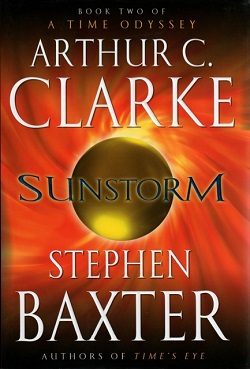
This is an excellent illustration for my next two book reviews. [Some spoilers, but nothing that you won't read by mid-book yourself].

These books are Time's Eye and Sunstorm,books 1 and 2 in theTime Odyssey series by AC Clarke and Stephen Baxter. "Time Odyssey" seems to be a quick brand extension of the "Space Odyssey" that brought Sir Arthur so much fame. The other bit of history I will add is that these two were collaborators since they wrote Light of Other Days together.

Now, I like AC Clarke books, and I like Stephen Baxter stories, but the collaborations don't quite hit the same right note. That said, the books are good enough for fast reads.

Unfortunately, the older I get, the more nitpicky I get (the polite term people use around me is 'over-analytical'). The plots are fine, the technicals are all fine, but somehow, in these collaborations, the characters don't quite get to be people I care about.

Time's Eye is the better story of the two. Bisesa Dutt, a lieutenant (why do they spell it this way and pronounce it leftinant?) in the British Army in 2037, is seconded to the UN, and she is flown into a time-slip in a helicopter crash. Along with her and the chopper crew, arbitrarily selected people from all over the past are also time-slipped into a patchwork world, watched by the sinister Time's Eyes. The cast includes Rudyard Kipling, Alexander the Great and Genghis Khan (not Chengez Khan?), and the more straightforwardly fictional Casey and Josh from the USA, Abdikadir the Pashtun, Kolya the Russian and Sable the abrasive black woman astronaut. Kolya the Russian cosmonaut knows all about English history, and looks down on London from space with nostalgia and fondness (but not Moscow). Bisesa, the third generation Indian-origin Brit, has a daughter named Myra. So why is she 'Bisesa' (which, if I guess the language right, means 'special')?

Gaah. Anyway, we meet some proto-humans, a war, and Bisesa using cobbled-together electronics from a crashed copter to 'sense' the purpose/sentience behind the Eyes. We get pop intros to string theory, and poor Pauli's exclusion principle once more gets pop treatment: 'mind' results in observations at the quantum level. Gaah.

Anyway, no spoilers for the end, but Bisesa shows up in the sequel, Sunstorm.The sequel starts with the last chapter of book 1. Bisesa reaches home, London. The world has a Prime Minister of Europe, another one in the UK, both female, a female Spanish President of the USA, and assorted other female politicians. The exception is the European President, who is the King of the UK, having been mysteriously elected unanimously. Gaah moment again. Anyhow, fortunately, the action is provided by a student of the Sun predicting a major solar storm correctly, and so getting taken seriously when he predicts the sun will explode in 5 years. Ha ha ha, laugh +Camilla Corona SDO and other academics. The whole world starts to work together to avoid mass extinction. A shield is created (ha, I guessed that is what they'd do, since, as the book says, this is no asteroid we can push aside, this is The Sun!) Here's the spoiler: the Firstborn (the sentience behind the Eyes) is behind the blow-up.

Oh well, I guess I'll go look for the sequel to see what happens when humans locate the Firstborn. But, hey, not with breathless enthusiasm.

In the meantime, enjoy these pix of solar plasma ejections from the Sun, via+Camilla Corona SDO , and be grateful that some people still find solar study exciting and sexy. Maybe we will get a real-life Eugene. If not crowds of women politicians, world-spanning AIs, ubiquitous softwalls for communication, and a manned Mars landing by 2042. And, yes, there will really be a solar eclipse then. :)

SF keeps December warm in the northern hemisphere

Science Fiction | Harry Harrison
Since I posted last, I reread Harry Harrison's The Jupiter Plague.


Harry Harrison has written an incredible number of books, ranging from silly easy reads to thought-provoking easy reads. He's written science fiction, comedy (the Revenge series, e.g. Queen Victoria's Revenge), and comic science fiction, and goodness knows what else besides, not only in English but in Esperanto. The Jupiter Plague is straight science fiction.
It features Dr Sam Bertolli, an ex-UN Army man who becomes a late student. As an intern on the ambulance detail, he gets to meet up with the long-missing and recently returned "Pericles", a ship that actually landed on Jupiter and returned. A member of the crew emerges, falls sick and dies despite the best efforts of Sam and Nita Mendel, a pathologist, dies. And he's locked the ship tight. Everyone worries about another plague (there was one when the first expedition returned from Venus), and a team is formed to analyse this new disease. Next you know, birds are dropping dead. Infected birds infect humans and birds, but humans don't infect humans. So, they try to cull all the birds. Ha, you say to yourself, like the bird flu thing a few years ago. Yeah, but this book was written in 1965 and revised in 1982.

Anyway, some people protect their birds, but others attack them. Then the whole area goes under quarantine, but a mob breaks out. And in the meantime, dogs start getting it from birds, and transmitting back to humans.

OK, so in the 1960s, humans were special, and a plague would naturally attempt to attack humans, right? Not fish or prokaryotes, right?

Never mind. At some stage, Sam realises that he needs to reexamine the ship before the panicked world leaders camped in Geneva drop an atom bomb on the city.

OK, OK, you don't want any more spoilers. :)

A thought-provoking book with a nice open ending.

Another of my favourite Harry Harrison fast-action-think-later books is Invasion Earth, where again the woman in the story has a totally different view of the situation, partly 'cause she's Russian--maybe. And it has two different, new aliens.
  

Other Harry Harrison books which are great fun are the Stainless Steel Rat series, the Deathworld trilogy, and One Step from Earth. His series on Bill the Galactic Hero is a comic army story based in the far future, but it's basically different episodes of the same concept, and the first in the series is the best. (And, yes, the artist who drew the cover can draw well; read the book if you don't believe how well).

If you haven't read Harry Harrison, start now.

Oh, still November, re-reading yet once more

Science Fiction | Hal Clement


Currently re-reading Hal Clement's Needle


This book was first published in 1949, way before most of us were even born. Hal Clement was a school teacher of physics, and most of his books feature aliens and/or kids. This one is no different, it has both. :)


It also has these reminders of the 1940s, which are just as often double-take moments as quaint and somehow cute. A population of 2 billion. Only! 15 year olds on bicycles, who also drive jeeps and casually ask permission to go blow up something with a stick of dynamite. (What!?) And turbo-prop planes, while the biology people have created bacteria that convert vegetable matter to oil. And a school syllabus of English, Physics, Latin and French. I kid you not.


So, the alien, a virus-based lifeform with amoebic shape, crashlands on earth while chasing an alien murderer. Being a symbiote, it hunts for a suitable host. Kills a shark (unsuitable), but then finds a boy. So, now the Boy holds the Fate of Earth in his Hands. Because the alien enlists his help in hunting down the villain. Who is hidden in the haystack of 2 billion, and the needle, as the book says, has crept inside one of the straws.


The first 70 pages cover the story till the point that the alien establishes communication with the boy he lives within, and persuades him to return to Hawaii to track down the criminal. I'm about at this point.


OK, I've forgotten who is the person who ends up harbouring the villain, and whether he did it voluntarily or not, and how the villain was tracked and arrested, and how they went home. But it's a Hal Clement book. Happy endings for all. :)


Anyway, I strongly recommend Hal Clement books for young teenagers of all ages. He used to check experimentally all the weird atmospheres and reactions he reported (except probably Mission of Gravity).


More Hal Clement books I've enjoyed: Mission of Gravity, it's sequel Starlight, Close to Critical, Nitrogen Fix and even Iceworld, whose gangsters and cops aliens compensate for the thoroughly dated humans in it.


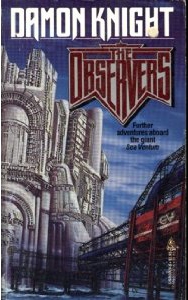
More books/stories about intelligent alien symbionts: Damon Knight's series CV, The Observers and A Reasonable World, which feature their own set of baffling humans and straightforward symbionts. Robert Silverberg's stories, Amanda and the Alien, in which again, Amanda is the weirder, and The Symbiont, a creepy piece that will stay with you long after it's done (both stories are in his collected stories vol 1: Pluto in the Morning Light).


Still November, still re-reading


Science fiction | Larry Niven

Recently re-read Larry Niven's A Hole in Space, a collection of short stories. My last post on the topic covered the first three stories.


All the Bridges Rusting is a space story based on the instant-elsewhere booths manufactured by JumpShift. Some have been put on drop-ships, whose only purpose is to absorb the enormous potential energy differences between the spacecraft here and the spacecraft out there. Some are self-transmitting ships. In the meantime, thirty years before, a slowship had set out to explore planets around Centaurus. The transfer booth ships reach first, and find the old ship is in trouble, not having made its slowdown maneuvres. Now, it's zipping along at 7% of the speed of light. Dr Robyn Whyte, ex-head of JumpShift, is faced with the impossible rescue, and how to explain it to a public no longer interested in space. Prophetic, that last. This is Larry Niven in ideas mode.

There is a Tide is the earliest Louis Wu story. Louis Wu stars in Ringworld, and in a few earlier stories. In this one, he is out alone, looking for stasis boxes left behind by the extinct rulers of space, the Slavers. He finds what seems to be the biggest one ever found, but things are not simple. Another, new alien species, has found it at the same time. Fight, flight, or gamble? This one is in way-out problems mode. Larry Niven loves tides. Read Neutron Star if you don't believe me.

Bigger than Worlds is a madcap essay, covering all kinds of giant spacecraft, why we will need them, and how they will get inevitably bigger with our overcrowding problems. Not fiction, but a tremendous display of science writing at the edge of fiction.

$16940.00 is not a science fiction story. It's about a blackmailer, and the blackmailed, and how they are tied together, and ... just read it, ok.

The Hole Man was written when the first quantum black holes were postulated. As Niven's friend Jerry Pournelle gleefully cackled later, Niven got into print about quantum black holes before Pournelle, but the science is wrong. Quantum black holes are black body emitters. Ah, dang it, it's a murder mystery. Of sorts. You realise only later that there are two murders, not one. This was an award winner.

The Fourth Profession is one of the eeriest Larry Niven stories I've read. The Monks, space aliens, visit Earth. One of them walks into a bar... OK, I should stop laughing. The bartender discovers more than he finds comfortable. Now only he can save the Earth... If you ever get a chance to read this one, do. It's Niven at his maddest inventiveness. It's also a story that showcases why Niven stories age so slowly in many ways. He was ahead of the times.

Anybody interested in more thoughts about instant-elsewhere transport? Try Harry Harrison's One Step From Earth.


Next up: Re-reading Hal Clement's Needle

If it was November, we must have been re-reading


Science Fiction | Larry Niven and Jerry Pournelle

Recently re-read: The Mote in God's Eye by Larry Niven and Jerry Pournelle


In 1975, Larry Niven, the guy who populates short stories with more ideas than many another author feels overcrowds a trilogy, teamed up with his long-time friend Jerry Pournelle, who writes military SF and the Chaos Manor chronicles, to come up with a story of first contact with an intelligent alien species. They wrote a follow-up in 1993, which I'm currently reading, called The Gripping Hand.

Mote is placed in Jerry's universe of the CoDominium, where the Space Navy protects the Second Empire, and is busy reabsorbing, sometimes by force, planets that descended to chaos during the Secession Wars. Having lost much of the advanced tech of the revered First Empire, the humans have tech which we readers can relate to (mostly; I'll come to that later). They then detect an alien craft decelerating into one of the Trans-Coalsack worlds. From that world, the Coalsack nebula looks like a hooded man, with a red eye (giant star) with a yellow mote (companion star). It's a light sail.

Rod Blaine, the new Captain of the MacArthur meets this probe, and is then appointed on the expedition to the Moties' planet. The Moties turn out to have idiot savant Engineer sub-species, and a whole set of other species, including almost-mind-reading Mediators. There is a mystery involved, but I'll not give you any more spoilers. :)

I've never quite understood the penchant of SF writers to imagine Emperors and Dukes and stuff way into the future. Surely, even if we lost a lot of tech for assorted unexplained reasons, including interstellar wars (!), we wouldn't regress to feudalism? It's surely easier to retain social advances than high tech, which, by definition, needs a pyramid of tech to sit atop. THis book also has The Church, which does not help me understand the USA either (all SF more reflects the life and times of the authors than the future they imagine and, if they are bestsellers, the life and times of the target demographic). Anyway, the future society also has a very 1960s attitude to women, of which we have just one, the Lady Sally Fowler. We have a sinister trader, Sir Horace Hussain Bury, predictably (this was written at the time of the first Oil price Shocks) Muslim (Moslem, in the book) and cunning. We have the sailing master, Kevin Renner, a very Larry Niven character, full of irreverence and ideas. And we have the Moties, who have three arms, two on the right, most of whom are female, most of the time.

The tech of the space drive is still futuristic. It is based on the Alderson Drive, 'invented' in real life by the JPL scientist Dan Alderson, and a bit of a wormhole process. There is also the (ahem!) Langston Field, which protects the ships from laser and missile attacks. The tech, predictably, falls short when it comes to computers, but surprisingly, not very short. The book has pocket computers, linked to the ship's mainframe, which has all the data stored in it. In the 1990s, this was laughable, but in these days of cloud computing, it's very close to high tech today. The machines are voice activated as well as taking stylus inputs (we've moved beyond, heh heh). The culture that takes wine and whisky is contrasted with the one that takes coffee, which in turn is contrasted with one that takes tea. And once, it is pointed out that most of these cultures are based on what the people then imagine as the authentic version of 20th century Earth. Again, why anyone should aspire to 20th century cultures is mysterious in reality, but not if you want to sell your books. Along the way, we find the Moties have superconductors of heat (not as much of an oxymoron today, very much so in the 1970s), a frictionless toilet, and a superior coffee-processing surface, though they can't stand coffee themselves.

Quote from when the humans land on the Motie planet:
"Blasted show offs," Renner muttered to Bury. When the Trader looked at him quizzically, Renner pointed. "There's city all around, and the airport's got not one meter of extra space."
Bury nodded. Around the tiny field were skyscrapers, tall and square-built, jammed close together, with only a single belt of green running out of the city to the east. If there were a plane crash it would be a disaster--but the Moties didn't build planes to crash.
You'll love and fear the Moties, like the humans in the book do. A very tightly written story, with suspense all the way up to the last few pages. The mystery is solved, and so is the moral dilemma: do you look at an alien species from what benefits they can offer or from what peril they can result in. I don't like sad endings, they prevent me from rating a book high. This book gets a high rating. It still remains one of Niven and Pournelle's best books. Read it.

October 2011, SF and fantasy


Science Fiction, Thriller | Elizabeth Moon, Jeffery Deaver


I've finished re-reading the Serrano series by Elizabeth Moon. Sigh. I wanna a Margiu Pardalt story. Wanna. Wanna. Ok, never mind. I must point out that this series is much more deserving of the name 'military science fiction' than Lois McMaster Bujold's Vorkosigan series (wait for me to reread :) ). And has a lot of very strong heroines, with good support from the heroes.


FYI, more military SF comes from Eric Flint (mostly re-written historical stories; very good) and David Weber (more futuristic, rather grim; but I've read only a few). There is always the old Berserker series by Fred Saberhagen for die-hard fans, but it hasn't dated well.


Back to Serrano. Book 6 in the Serrano series is Change of Command and book 7 is Against the Odds.


In Change of Command, the Speaker gets assasinated on page one. The evil Lepescu's protegee takes over a prison camp, and seeds a Mutiny in the Fleet. Cecilia runs hither and yon solving people's problems and still being called irresponsible. Brun's mother finds out who killed her husband. Methlin Meharry's brother almost saves everyone. We meet Margiu Pardalt. We also meet Goomar Terakian and his carefree cousin Basil. Brun is visited by a most unexpected Ranger from the Lone Star Federation. The New Texas Militia hit a station. The station hits back. Vida Serrano finds out unexpected things about Altiplano. All in all, not a book you should start reading unless Against the Odds is ready to hand the minute you finish. I honestly wonder how the early readers survived the gap in publication between the two books.


Breathlessly, I flipped the pages quickly to the last of the series, Against the Odds. All the problems I mentioned above are resolved, including new ones like Esmay Suiza gets kicked out of Fleet for marrying Barin. Barin gets into an explosion. Heris gets inexperienced crew. In the interests of avoiding spoilers, I shall avoid mentioning that one of the characters gets killed. Oh, actually, whole lots of them do, especially the villains. :) The Benignity does strange things. The Familias history is explained.


Here is a quote from Against the Odds, since I cannot immediately find the one on religion that I particularly liked (ah, rats, books should be searchable):


"It's not a race."
"Sir?"
"It's not a race. Marriage. There is no "behind" or "ahead". You're not in competition; you're a partnership."


Enjoy!


Currently re-reading: The Coffin Dancer by Jeffery Deaver. Part of the Lincoln Rhyme series, in which a C4 quadriplegic forensic criminologist races to detect the villain before he murders more people.