13 August 2016

The Establishment or the Rebellion?

Science Fiction for Young Teens | First Duty | Marva Dasef
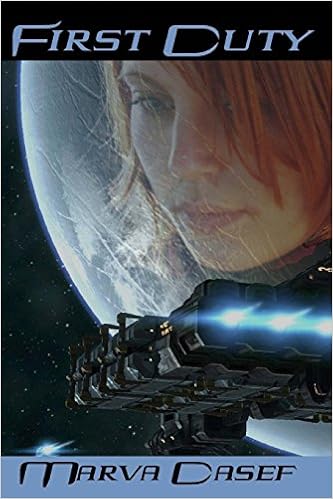

I know Marva Dasef as the author of the gentle, imaginative and exploratory books of the Abu Nuwas series, and so I was looking forward to First Duty, bearing in mind, of course, that this time we are talking science fiction and not fantasy. I’ve also read her other fine books, Lemons and Other Kid Tales and Fish Story, so I grabbed the chance to pick up First Duty on a hefty discount when Marva Dasef did a giveaway. I was pretty confident I’d get something suited for kids of ages 12-90. No gruesome horrors, wicked but not evil villains, simple but not simplified plots.

First Duty does not quite pull off the same standards. Don’t get me wrong: the writing is crisp and the editing flawless, which already lifts the book head and shoulders over most indie books. But it’s in the reasoning that it stumbles. When Abu Nuwas asks a young boy whether it is right for girls to be disallowed from certain activities, he lets the boy reason it out for himself. Nyra, the protagonist of First Duty doesn’t quite reason anything out. She goes from action to action much like a TV serial heroine. There are twists and turns in the plot, but none of the mind. Freedom is presented to us as an unalloyed good, losing the chance to explain to young readers what exactly is wrong when corporatisation of whole planets results in poorly-fed slave labour. The desperation of the tall and martial-arts-talented Nyra to get off-planet is there, but there is no back-story to explain why. We know there is inequality in the whole setup, but we barely brush the fringes or implications of it.

Nyra survives the initial test (ha, you guessed that, did you?) and the first chapters did bring out a bit of the heartlessness of the system in that cadets could be and did get killed in the last test, for no real reason other than ‘testing’. She then is part of a mission to deliver a rebel to prison, where she gets to know for the first time that there is a rebellion, and what the reasons for it are (freedom, equality).

At this point, I felt that Nyra is a naif. But is she? She’s supposed to be one of the smartest cadets, and she is selected, after all, to infiltrate the rebels, once she’s presented that plan as a fait accompli. So, plenty of initiative, smarts, physical capability, and perhaps charm, to be able to convince the rebel leader she is a committed rebel.

She meets a lot of rebels, and finds out more about the status of the rebellion on her own home world, something she had been blithely ignorant of. Are real teens that ignorant? It’s possible, but surely a sharp young woman like Nyra would have known something more than she does. Or is she like the many one-track minds one sees alas too often in academia, someone who scores well by single-minded focus, and therefore not a rounded personality with other interests?

She goes from adventure to adventure, with a final result you can expect from reading the back cover or my own headline for this post (spoilers? Who, me? Never!) And yet, somehow, it seems not to quite touch her at any depth. Not the unexplained sexism of her first Captain, nor the suspicion of the second. It’s all: huh, I shall prove to you that I am capable. Nyra is too perfect already, there is no scope of showing growth in the character.

Another lost opportunity is the Vargans, including one of Nyra’s few friends, Smith, who is her contact back to headquarters, someone who follows her into the rebel stronghold under the guise of a romance. Dasef has created a super-race of humans adapted to extreme environments, one of whom is the laid-back Smith. However, the special organs and abilities don’t actually have anything to do in the story. I hope the sequels will put these to better use.

All in all, a light read, with a light touch, and a light treatment. Anyway, I’m off to read the first of Marva Dasef’s Witches of Galdorheim.

19 July 2016

A 17 year old tackles visions of deadly future danger


Fantasy, YA | Future Tense | LJ Cohen

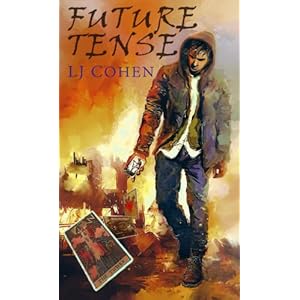
Matt is 17, going on 18, and haunted by visions of the future. As a kid, he'd had a vision of a fire, and soon after, his parents had died, leaving him an orphan, in and out of foster homes. Mr and Mrs Powell, who foster other children than Matt as well, are good people, but Matt worries that his visions of death and pain would envelop anyone he cares for—and they would die horribly--and so all he looks for is to 'graduate' foster care when he hits 18. He's trying not to rock the boat.

Then he meets Amara, and Amara's great-aunt. Amara's in his school, and their first encounter is Matt inadvertently and anonymously saving her from a group of bullies. The more Amara tries to understand what Matt is about, the more he tries to push her away. Not that he can. Amara's blind great-aunt reads tarot cards, and sees the 'gift' in Matt.

Now, that's the point at which I would normally flap my hands in exasperation and abandon the book, because, I mean, tarot? One step below astrology, the way I look at it. I mean, I was looking at a fantasy book, not a superstition book.

But LJ Cohen's writing dragged me into the story. By the time this came up, I was totally involved with the characters, and I wanted to know how a happy ending could possibly be pulled out of those dark and dangerous visions. It's a fantasy book, and tarot is just a prop for parts of it. You could replace it with potions if that makes you feel happy. (LJ Cohen later told me on her Google+ profile that she uses tarot as a plot-advancing device and does not advocate it, so there. And yes, that does mean the author is accessible to fans).

Suffice to say that said happy ending occurs, after a breathless rush through a fast-paced story with characters you really care about, credible villains, heroic actions, and suitable comeuppance for the wicked. Which is not to say it's a bloodless story. People get hurt, some badly. It's all very credible and real, and you feel every emotion along the rollercoaster of the story.

Do I recommend this book for young adults of all ages?

Do I, indeed!

21 January 2015

Best-selling garbage

Fantasy | Deeply Odd and Innocent | Dean Koontz

I made the mistake of picking up two books by Dean Koontz, misled by the blurbs into thinking that they would be mildly entertaining fantasy. Instead, they are the worst of sanctimonious Christian-themed moralising, slightly worse than Christian-themed B-grade American movies. The characters are stereotypes, the fantasy is heavy-handed and one-dimensional, the moralising is constant, grating, and soaked with Christian religious assumptions and new age nonsense.

In Deeply Odd, the main character has a 'psychic magnetism' which helps him identify evil people. One of whom is able to hide in a parallel dimension to avoid being noticed while he wreaks havoc, murdering parents and kidnapping children who are to be killed in a rite by a cabal of satanists to bring the devil into the world. Odd Thomas gets deus ex machina help from wondrous people who are all turning into 'smooth and fully blue' souls, whatever that means, and assorted ghosts. There is no real tension, the story is boring, the pace is plodding, and we are constantly told about his goodness in lengthy paragraphs divorced from the story itself. Most of the conversations are peppered with Thomas 'ma'am'ing the old lady who pops up in a souped-up limousine when he needs a ride. Each conversation belabours some silly point over two or three pages, which really needed a couple of crisp sentences.

Innocent is worse. Addison Goodheart has a face that immediately drives anyone who sees him, or even just his eyes, into attempted murder. Even his mother cannot resist beyond about 8 years, and commits suicide to avoid killing him. He reaches a city, where he is adopted by a man with the same kind of face. They hide in an underground room built long ago, furnished and having had electricity run to it, because god must have wanted it. Yes, seriously, that's what Koontz says. Food is 'donated' to them via a church where a 'good man' has given them a key to the storeroom. Education comes from midnight sallies to the local library. Addison meets a girl there, who is being chased by an evil man who steals antique books, has murdered her father (a millionaire) and wants to rape her. Yes, you guessed it, same as I did after about 20 pages: Addison looks so innocent that people immediately want to beat him dead. Seriously?? No, no, this is inevitable, because he does not have any original sin in him, and ordinary persons go into a frenzy of jealous murder at one glance. Eventually, everyone in the world is killed except a few kids like him and the girl, by a virus which the planet has come up with to finally get rid of bad humanity. The good priest restrains himself from killing them long enough to perform a Christian wedding ceremony. Dogs and kids live happily after on fruits. Fruits.

This author has a truly warped image of people. They are either idiots blundering through life with no purpose other than to provide victims for evil people, or so naturally bad that goodness drives them to murder. The goodness itself is so because it is declared so, and so saccharine that it is nauseous. Every fantasy trope from bad Christian American movies is there. There is no depth of characterisation, there is no tension in the plot, the situations are contrived and unreal, you can feel no sympathy for the protagonists, and no identification with their goals, let alone their thinking processes. Per Koontz, the only goodness in the world was in the 1930s or earlier. Modern life is inherently evil. The only good that technology brings is trucks and guns, which can be used to zoom up to and blow apart the bad guys. Government is in place only to give a chance for evil people to enslave the unthinking multitude with fear, despair, technology, whatever else he doesn't like. Perhaps excepting the god-ordained dollar.

I began to wonder why I bothered to learn to read if stuff like this litters the world! The tragedy is that these are best-sellers. Which perhaps explains why televangelists are millionaires, and why religious rightists are thriving. Now excuse me while I go off and retch.

01 January 2015

What's mind got to do with it? Mind is nothing but a second-hand emotion.

Psychology | Unthink | Chris Paley
“If the book we’re reading doesn’t wake us up with a blow on the head, what are we reading it for?” - Franz Kafka
Why indeed should we so waste our time? Just read Unthink and get a solid whack, one that turns out all the silly and wrong assumptions about what a mind is, and why we have one.

This book is a must-read for anyone who wants to know why we think. Almost every page had me going 'wow' and 'really??' and I read the book with a silly grin on my face most of the time. Read it. You'll never think of your mind the same way again. Read it. Leave that silly whatever-else-you-were-planning-on-reading and do yourself some good in 2015.

15 November 2014

Magic that works

Fantasy | Shadow Bound | Rachel Vincent

Again with the entry into a series in book two. Fortunately, this book doesn't require you to know anything about the previous book, since it is from a different main character's viewpoint. Smart going, Rachel Vincent!

You have people with magical talents, along with a whole lot of non-magical people. Now, unfortunately, by the time people realise they have talents, the criminal magical syndicates are after them. Their choices are to hide, or to join up.

Kori Daniels is a shadow walker, able to teleport between shadows, as well as a combat specialist. She is bodyguard to Jake Tower, who has put her to torture for not preventing an attack on his family. Thing is, while she is bound to him, by her sister's magic, her sister, a hugely powerful binder, is not capable of defending herself. Kori will do anything to keep her sister safe, including, in the first place, agreeing to bind herself to Tower in return for keeping her sister safe. Said sister having got herself bound to Tower by mistake a long time ago. In her childhood, she had also bound Kori to schoolmates, one of whom was able to use that to get her kid away from Tower (presumably in the first book).

Now, Ian Holt, a powerful dark maker, is being recruited by Tower. Kori needs to do that, to save her sister from torture. Ian wants to kill Kenley (the sister), to save his brother from the withdrawl symptoms of trying to disobey a binding. Except that said brother has no clue when Kenley did it (and neither do we, till close to the end of the book).

It's a romance, so Kori and Ian are falling in love, trying to prevent each other from being killed, while also trying to fulfill their oaths.

A well-built world, and you can cheerfully suspend your disbelief. Types of dark (infra-red lights prevent 'true shadow'), and ways to beat oaths, and how the criminal syndicates run the magical world—all well fleshed out and believable.

A good read, and I'm planning to seek out book one of the series.

Shenanigans in the Arctic

Detective | Breakup | Dana Stabenow

I picked this up because it is a book about detecting in the Far North, in Alaska to be precise. Kate Shugak has featured in six previous books, and fans probably know all the characters and react to them entirely differently from someone who dips into the series at such a late point.

Kate has inherited her grandmother's position in the tribe, something she is reluctant to own, as she feels she cannot fill her grandmother's shoes.

In the meantime, the weather is warming, and the ice is breaking up, hence the title. Breakup is also the word, used as a curse, by most of the characters in the book.

It starts with Kate getting excited about the warm weather (warm? When the ice is just starting to melt? But it seems it truly is warm for the denizens, and they will probably shift to t-shirts at 4 degrees. Well, I did pick a book about Alaska), and forgetting her rifle, whereupon she is attacked by a mother bear.

Safe at home (oh, come on, the book would have been really thin if she was killed by the bear), her meat store is attacked by another bear. After driving it off, she is almost hit by, of all things, a jet engine, which has fallen off a plane. It totals her truck, so she has no transport. She also has no money, and taxes are due. So, at least, there is plenty of mad action throughout.

The investigators descend on her house, and the bear comes by again. Followed by three off-roaders driven by drunk tourists. Then, an old dead body is discovered near her land. Her friend, who has abandoned a rich background to live off the land, comes up in a tizzy. Her parents have descended on her (again) and don't approve of her boyfriend, so she wants Kate to tour-guide them to any distance. In return, she gives Kate her truck, forever.

Whereupon, the three of them (Kate and the parents) are attacked by yet another bear. This bear, though, has killed and eaten a woman. The woman's husband is a woman-magnet, but also an object of suspicion by the cops. So, was it a murder? And how was it done? What about that original dead body? Was it an accident, or murder?

In the meantime, there are planes doing groundloops, old family feuds resulting in bars being shot up, an angry wife chasing her husband with a gun (and finally tying him up and threatening to kill him), and other assorted incidents which the tribe wants Kate to fix.

It's an old-fashioned detective story, in the sense that you get all the clues, and should be able to work it out for yourself.

It's also more about the shenanigans of Kate and her friends, so if all you want is a detective story, go elsewhere.

There's humour, but of the Patricia Cornwell variety, not of the PG Wodehouse variety.

A fair read, but one of this series is enough for me.